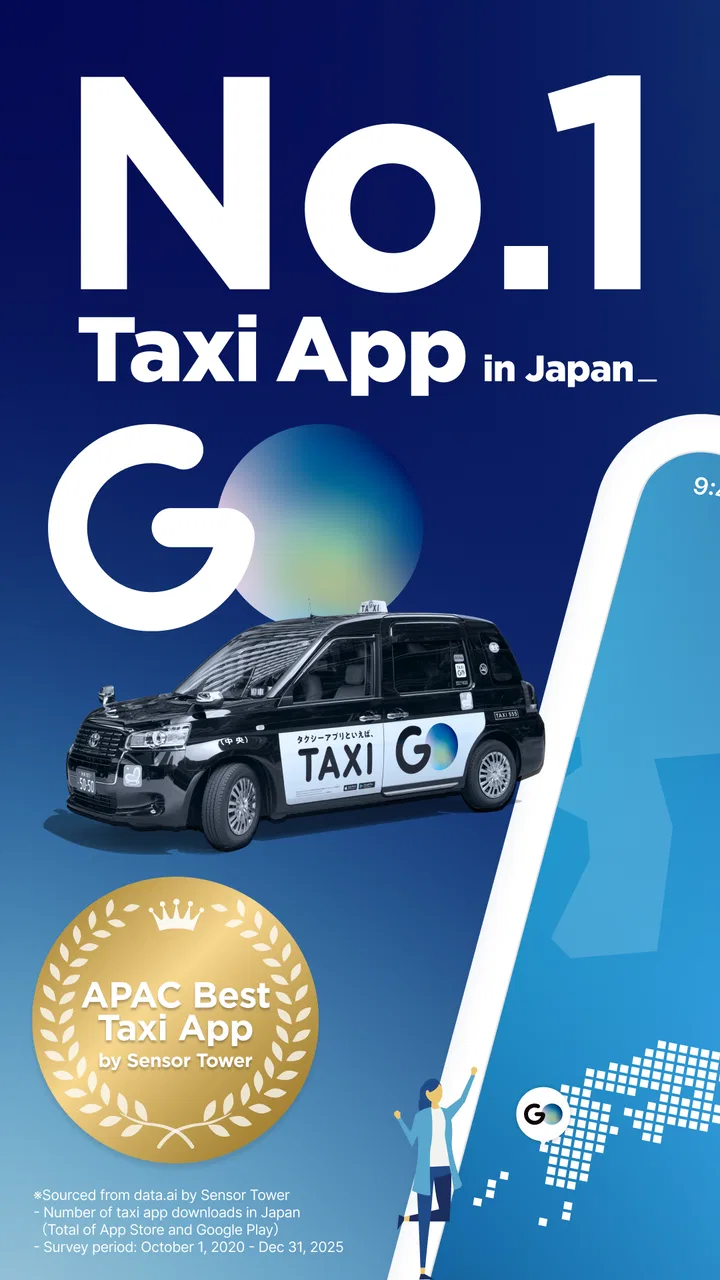
GO / Taxi app for Japan visit
- 4.3
- Rating
- 5.00M
- Installs
- Free
- Price

 Analysis by App-foxy
GO is a Japan-focused taxi app from GO Inc. that I found most useful when I wanted to arrange a ride without standing on a street corner and trying to explain my location aloud. It belongs to the Maps & Navigation category, but in practice it feels more like a digital taxi desk: you use it to request a car, manage the pickup, and reduce some of the uncertainty that comes with getting a taxi in an unfamiliar place.
The app is free to use, carries an Everyone age rating, and has reached over five million installs. Its average rating is 4.6 from around forty-nine thousand ratings, which suggests that many users find the basic idea dependable enough to keep using. I would not treat those figures as a guarantee for every trip, though. Taxi availability, pickup conditions, traffic, language comfort, and the layout of a busy Japanese street can still shape the experience more than the app itself.
My main interest in GO is how clearly it serves people in different situations. A visitor who cannot read Japanese comfortably, a passenger who finds phone calls difficult, someone carrying luggage, or a user who needs extra time to understand a busy screen may all approach taxi booking differently. GO can remove some obstacles, but it does not make every part of the journey equally accessible. That distinction matters before you rely on it for an important trip.
You May Also Like

 AccuWeather: Weather Radar
AccuWeather Review: A Quick, Clear Forecast for Everyday Decisions
For everyday plans, the best forecast is the one you can understand quickly. AccuWeather makes rain timing, radar, and local conditions easy to act on, with a few trade-offs.

 Hill Climb Racing
Why Hill Climb Racing Still Turns Crashes Into One More Run
A tiny car, a bumpy hill and one more upgrade: Hill Climb Racing keeps resurfacing because its simple chaos makes every near-miss feel personal.

 AliExpress - Shopping App
AliExpress Makes Global Shopping Feel Personal, but Shoppers Bear the Risk
AliExpress turns a global marketplace into a pocket-sized discovery engine. Its reach is useful, its shopping loop compelling, and its trade-offs easy to miss.

 Lords Mobile: Kingdom Wars
Lords Mobile Is a Kingdom-Building Routine, Not a Quick Match
A case-by-case verdict on the building, battles, device demands, and social commitments that make Lords Mobile rewarding for some players and exhausting for others.

 PDF Scanner app - TapScanner
TapScanner Makes Paperwork Easier to Capture, Check, and Share
TapScanner makes scanning with a phone feel less like a rescue operation and more like a dependable step in getting work done. Its capture tools are useful, though not flawless.

 Block Blast!
 Shows How Much a Puzzle Game Can Leave Out
A quiet grid game shows why puzzle players increasingly value instant clarity, repeatable skill and low-pressure play—and where the genre still needs to catch up.
More From Our News Desk
View All News


How readable navigation feels before and during a ride
I find readability matters most before I tap to request a ride: a clear, settled plan is easier to follow than trying to interpret a map while walking through a crowded station. I’d pause somewhere safe, check the pickup point against a recognizable entrance, and keep the destination ready to show if words are difficult. That preparation also helps reveal which parts of the journey may need a companion’s support.
A calmer alternative to finding a taxi on the street
The strongest part of GO is the change in workflow. Instead of scanning the road for an available taxi, waving at passing cars, or asking a hotel employee to call one, I can begin with the phone. That is especially valuable in places where several roads, station exits, and building entrances look similar. The app gives the booking process a defined starting point, which can be easier to follow than a conversation conducted under pressure.
For a first-time visitor to Japan, this can make the difference between feeling prepared and feeling stranded. I would open the app before leaving a restaurant or hotel, check the pickup point carefully, and only then move outside. That small habit reduces the chance of trying to complete the entire process while surrounded by traffic, people, announcements, and unfamiliar signs.
The interface is most helpful when I treat it as a planning tool rather than something to operate at the last second. I prefer to pause and verify the pickup location, especially near large stations. A station may have several entrances and taxi areas, and the nearest point shown on a map is not always the most practical place for a car to stop. A passenger with limited walking tolerance should pay particular attention to this step instead of assuming that “near the station” means “directly outside the door.”
Useful for people who find spoken instructions difficult
One quiet advantage of a taxi app is that it reduces dependence on spoken Japanese. I would not describe GO as a complete solution for language barriers, because the driver and passenger may still need to clarify a destination or a safe place to stop. Still, starting the request digitally can be less stressful than making a phone call, explaining an address, and listening for details in an unfamiliar language.
This matters for people with hearing loss, speech differences, anxiety around phone conversations, or simply limited confidence speaking Japanese. It can also help someone who is tired after a long flight. The app gives that person a more private way to begin arranging transportation instead of requiring a public conversation at a hotel desk or curb.
There is a practical tip here: prepare the destination before you are in a hurry. If you are going to a hotel, clinic, museum, or private address, keep the name and location available in a form you can show if communication becomes necessary. GO can help initiate the ride, but passengers should still have a backup way to identify where they are going.
Registration is less restrictive for some international users
A notable change for visitors is that a non-Japanese phone number can now be used for registration. That makes the first step more realistic for travelers who arrive with an overseas number rather than a Japanese mobile plan. I see this as more than a small technical detail: registration is the point where many travel apps lose international users before they ever reach the useful part.
Even with that improvement, I would complete registration while connected to reliable Wi-Fi or mobile data and before an urgent journey. A traveler should not wait until rain starts, a train has stopped running, or a child is exhausted before discovering that an account setup step needs attention. The easier the registration is, the more useful the app becomes in those moments, but preparation still matters.
What the screen cannot solve by itself
Clear digital navigation does not automatically mean perfect physical navigation. A map can show a pickup area while the real surroundings contain stairs, crowds, construction, narrow sidewalks, or a long route from the platform. For a user with a wheelchair, cane, stroller, balance difficulty, or low stamina, the final approach to the car may be more important than the booking screen.
I would therefore use GO alongside a simple landmark-based plan. Choose a visible entrance, a hotel lobby, or another place where waiting is safe and easy to explain. Avoid selecting a vague point in the middle of a large station complex. This is one of the most useful ways to make the app more inclusive without pretending that the interface knows every physical barrier around you.
Reading and attention in real-world conditions
Taxi booking is often done while walking, carrying bags, or standing in bright sunlight. Those conditions make small text, dense map information, and rapidly changing details harder to process. I found that the best experience comes from stopping somewhere stable before making the request. That is not a criticism unique to GO; it is a realistic reminder that navigation apps are used in motion even when their screens are not designed for distraction-free reading.
For users who process information slowly, I would avoid rushing through the request just because a car is nearby. Confirm the pickup point and destination in a quiet place, then move to the waiting area. A companion can also handle the screen while the passenger focuses on mobility or communication. That shared workflow is particularly useful for older travelers and families.
Motor, sensory, and situational access
When I think about access, I separate what the phone makes easier from what the street still demands. Arranging a taxi digitally can reduce walking, phone calls, and hurried explanations, but reaching the car and identifying it remain real-world tasks. In the next section, I look at how those demands vary with mobility, sensory needs, and the situation around the passenger.
Less physical effort, but not zero effort
GO can reduce several physical tasks associated with traditional taxi use. You do not need to walk around searching for a rank, raise an arm to flag down a car, or repeat your destination to several drivers. For someone with limited endurance, chronic pain, or luggage-related difficulty, that reduction can be meaningful.
However, the passenger still needs to reach the pickup point and identify the correct vehicle. If the app places the meeting point on a busy road or on the opposite side of a station, the remaining walk may be tiring. I would not use the app as a substitute for checking the route from your current position to the pickup location. The booking is digital, but the handoff is physical.
There is also a motor-control consideration that is easy to overlook. A user with tremors or limited dexterity may find map manipulation and precise point selection frustrating, particularly when the pickup area is crowded. The safest approach is to set the point while seated or supported, use a familiar landmark, and avoid repeated adjustments after stepping into traffic or a dense crowd.
Support for hearing and speech differences
GO is naturally appealing to people who prefer text and visual interaction over phone calls. A person who cannot hear a call clearly, who uses a hearing aid affected by background noise, or who has difficulty speaking may feel more independent starting the taxi request through the app. A visual booking process can also help a companion understand what has been arranged without relying on a spoken explanation.
Still, the arrival stage deserves planning. A driver may need to locate the passenger in a complicated area, and a passenger may need to recognize the correct car. If speaking is difficult, keep the destination and a short written explanation ready on the phone. If hearing is difficult, stay alert to visual cues and choose a pickup place where the vehicle can be identified without depending on an announcement.
This is where GO works best as one part of a communication plan. It can reduce the amount of speech required, but it cannot guarantee that every interaction will be silent or perfectly understood. I would recommend it to users who want fewer phone-based steps, not to anyone expecting the app to remove all communication at pickup.
Low vision and screen-dependent use
People with low vision may appreciate not having to search the street for a taxi, but a map-centered task can still create difficulty. Pinpointing a location, distinguishing nearby roads, and reading changing pickup information may require more visual effort than simply asking a staff member at a hotel or station. Whether GO is comfortable depends heavily on the user’s phone settings, assistive tools, and familiarity with map apps.
I would test the complete process before depending on it alone. Try registration, choosing a pickup point, and reviewing the ride information in a calm environment. If the text or map is difficult to interpret, a companion or a staffed location may be a better part of the plan. This is a case where a traditional alternative can be more accessible even though it involves more human interaction.
Traveling with children, luggage, or a companion
One realistic use case is arriving at a large station with two suitcases and a tired child. Instead of sending one adult outside to find a taxi while the other watches the luggage, I would arrange the ride first, choose a simple meeting point, and move together only when the plan is clear. That reduces unnecessary walking and keeps the group coordinated.
The same method works for a passenger assisting an older relative. One person can manage the phone while the other remains seated or stays near the luggage. The important detail is to avoid choosing a pickup location that forces the person with limited mobility to cross a wide road or navigate a complicated station exit. GO helps with coordination, but the companion still needs to make the physical-access judgment.
When a different option is better
I would skip relying on GO alone if I had no dependable data connection, a phone with very little battery, or a destination that required highly specific vehicle access. In those situations, a hotel, station information desk, or local taxi rank may provide more immediate human assistance. A street taxi can also be better when one is already waiting nearby and the passenger does not want to spend time entering details.
For a person who strongly prefers face-to-face help, the app may add an unnecessary digital layer. For someone who needs a vehicle with particular accessibility equipment, I would seek direct confirmation rather than assume that a normal taxi request guarantees a suitable car. The app is most convincing when the main problem is arranging an ordinary taxi with less uncertainty, not when the trip has specialized transport requirements.
Practical barriers that remain
GO cannot control every part of a taxi journey. A pickup point may be difficult to reach, traffic may delay the car, and a busy area may make the passenger hard to find. These are ordinary transportation problems, but they affect disabled travelers and anxious passengers more severely because improvising at the curb can be exhausting or unsafe.
I would build in extra time and choose a waiting place with shelter when possible. Keep the phone charged, remain somewhere visible, and avoid moving far from the selected point unless the situation clearly requires it. If you have a mobility or communication need, tell your companion the plan before the request is made so they can help if the handoff becomes confusing.
Another barrier is confidence. A visitor may assume that a digital request means the journey will be completely automatic. It is better to think of GO as a bridge between planning and transportation. It makes the request more structured, but the passenger still has to interpret the surroundings, reach the vehicle, and handle exceptions.
What the current app details mean for compatibility
The current version is 9.10.30, and the app requires iOS or Android 11 or later. That requirement is worth checking before a trip, especially if you are using an older spare phone or borrowing a device from a family member. A technically incompatible phone is an accessibility problem in itself because it can remove the planned transport option before the journey begins.
I also like that the app is free to install, since cost is less of a barrier when someone wants to test the workflow before traveling. Free access does not remove the cost of the taxi ride itself, so I would separate the app decision from the transportation budget. The useful question is whether the booking process makes the ride manageable for you, not whether installing the app makes the journey free.
My inclusive verdict
After looking at GO through the lens of different abilities and travel contexts, I see it as a practical accessibility aid rather than a complete accessibility solution. Its biggest strength is reducing dependence on street searching and phone calls. That can support visitors, people with hearing or speech differences, passengers who feel overwhelmed by unfamiliar surroundings, and anyone who needs to coordinate a ride before leaving a safe indoor place.
The non-Japanese phone number registration option also makes the first step friendlier for international travelers. Combined with its free availability and broad adoption, that gives the app a credible place in a Japan travel plan. I would install it before a trip, complete the account setup on a stable connection, and practice selecting a pickup point before an urgent journey.
My recommendation comes with a clear condition: plan the physical handoff as carefully as the digital request. Pick landmarks rather than vague map points, allow extra time, prepare written destination details, and keep a human backup available when mobility, vision, hearing, or communication needs are significant. Those habits turn GO from a convenient taxi button into a more dependable part of an inclusive travel routine.
For ordinary taxi trips in Japan, I think GO is worth trying, particularly if you dislike phone calls or worry about explaining your location. It is not the right sole option for every passenger, and I would choose a staffed taxi service or direct assistance when specialized vehicle needs or complex physical access are involved. But for many travelers, the app offers a calmer starting point and fewer avoidable barriers than searching for a taxi at the curb.
GO is developed by GO Inc. and was released on February 17, 2023. Its Everyone rating makes it suitable for a wide audience, while the mature version history suggests it is an established travel tool rather than something I would treat as experimental. My final view is simple: use GO to simplify the request, not to stop thinking about the journey. That balance is what makes it genuinely useful for different abilities and real-world situations.
FAQs for GO / Taxi app for Japan visit
01Is the GO / Taxi app available in multiple languages?
Yes, the GO / Taxi app offers multiple language options to cater to international users visiting Japan. This includes English, Chinese, and Korean, among others. You can easily switch the language within the app settings, ensuring clear communication and a user-friendly experience while navigating through Japanese cities.
02What payment methods does the GO / Taxi app support?
The GO / Taxi app supports a wide range of payment methods to offer convenience to its users. You can pay using credit or debit cards, digital wallets like Apple Pay and Google Pay, or even cash. The app ensures secure transactions, making it easy for both locals and tourists to use.
03How reliable is the service during peak hours?
The GO / Taxi app is designed to efficiently manage demand, even during peak hours. The app uses smart algorithms to optimize taxi availability, reducing wait times. However, during extremely busy periods, you might experience slight delays. It's advisable to book in advance when possible to ensure timely service.
04Does the app provide fare estimates before booking a ride?
Yes, the GO / Taxi app provides a fare estimate before you confirm your booking. This feature helps you understand the approximate cost of your trip based on the distance and current traffic conditions. It's an excellent tool to budget your travel expenses in advance, ensuring transparency and convenience.
05Can I schedule rides in advance using the GO / Taxi app?
Absolutely! The GO / Taxi app offers a ride scheduling feature that allows users to book their rides in advance. This is particularly useful for airport transfers or early morning departures. Simply select your desired date and time, and a taxi will be reserved for you, ensuring a stress-free travel experience.
Pros
- Easy navigation for tourists.
- Quick booking with one tap.
- Supports multiple payment options.
- Includes English language support.
- Real-time fare estimates available.
Cons
- Limited rural area coverage.
- Some drivers lack English skills.
- App may crash on older devices.
- Occasional GPS inaccuracies.
- Limited customer support hours.

GO / Taxi app for Japan visit
Gallery